What UK Guidance Says About Weighted Training for Bone Density
As an Amazon Associate we earn from qualifying purchases. Some links on this page are affiliate links, which means we may earn a small commission if you make a purchase.
Search “rucking bone density” and you land in one of two camps. One insists a weighted vest will show up on your next DEXA scan. The other warns that any extra load on ageing bone is asking for a fracture. Almost nobody in either camp quotes where their argument actually comes from.
The NHS and the Royal Osteoporosis Society (ROS) have published specific, practical guidance on exercise and bone health — it’s just a few clicks into their websites rather than the top of a Google result, so most fitness content paraphrases it instead of reading it. Neither body mentions weighted vests or rucksacks by name, either. That’s a gear-industry translation layered on top of the actual guidance, and translations can drift.
This article works from what the NHS and ROS actually publish, not the gear-marketing version of it. The honest answer sits between the two camps above: weighted gear can fit into a bone-friendly routine, but only once you understand the mechanism bone actually responds to, what UK guidance actually recommends, and where a vest and a rucksack pull in different directions. Here’s how that plays out — and where the real dividing line sits.
The UK Consensus on Bone Health
The NHS states plainly that exercise helps keep bones strong, and that a combination of weight-bearing activity and muscle-strengthening work does the job. The Royal Osteoporosis Society (ROS) breaks this into two recognised categories: high-impact, weight-bearing activities — running, skipping, dancing — and muscle-strengthening exercise, which covers resistance training and weight work.
Where ROS goes further is on the impact side. Their exercise guidance specifically references moderate impacts — things like brisk walking, jogging, hopping, or skipping — as the stimulus for the hip and spine. The exact figures for recommended impact frequency are best pulled directly from the live ROS source at the time you’re reading this, because clinical guidance does update. Check the current numbers at theros.org.uk itself rather than trusting a figure quoted secondhand.
What UK guidance is consistent on, across NHS and ROS alike, is that exercise should be adapted to the individual — and that includes anyone with a diagnosed fracture risk or bone density concern. That’s the part that often gets dropped when rucking culture overlaps with bone health advice: the “adapt to the individual” bit.
The Mechanism of Bone Loading
Bone is living tissue, and it responds to mechanical strain — specifically, the forces placed on it during physical activity. There are two main ways that strain gets applied.
The first is impact — ground reaction force travelling up through the skeleton during running, jumping, or hopping. This high-impact loading is particularly effective at stimulating the hip and spine, which are the sites most associated with osteoporosis-related fracture risk.
The second is resistance — muscles contracting forcefully against a load, pulling on the bones they’re attached to via tendons. When you push or pull against resistance, the skeleton experiences localised stress at the muscle attachment points, which signals those areas to strengthen.
This is where weighted gear comes in. It allows you to add load to your skeleton without necessarily adding the high-impact forces of jumping. You can stimulate bone through resistance without the joint jarring.
For someone who finds running uncomfortable on the knees, or who wants to work around mobility limitations, that distinction matters a great deal. A rucksack or weighted vest doesn’t replicate impact loading, but it does provide a meaningful resistance stimulus — a genuine alternative for people who want bone-friendly training without the bouncing.
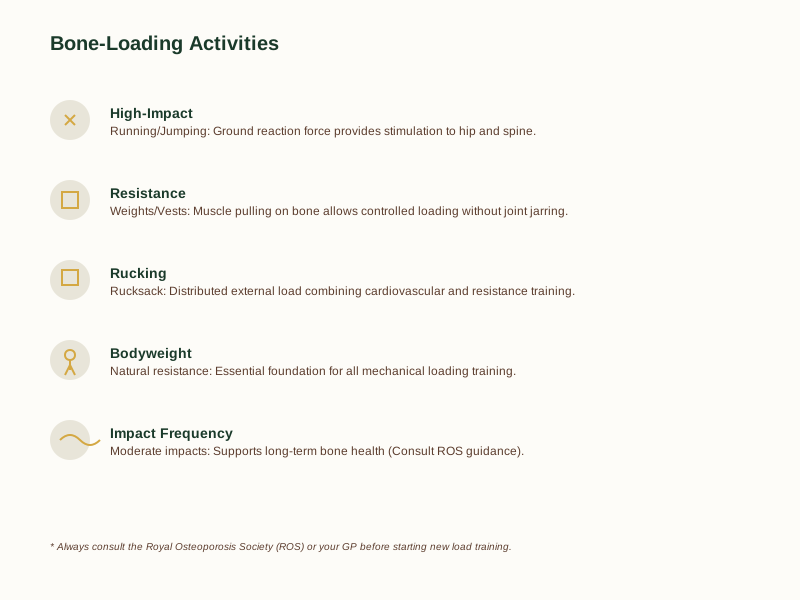
As a quick reference, here’s how each mechanism maps to what it’s actually good for:
| Activity Type | Mechanism | Best For |
|---|---|---|
| High-Impact (Running/Jumping) | Ground reaction force | Hip and spine stimulation |
| Resistance (Weights/Vests) | Muscle pulling on bone | Controlled loading without joint jarring |
| Rucking (Rucksack) | Distributed external load | Cardio and resistance combined |
| Bodyweight | Natural resistance | Foundation for all training |
| Impact Frequency | Moderate impacts | Hip and spine health (check theros.org.uk for current figures) |
Weighted Vest vs. Rucksack: Which Adds Load Safely?
Here’s the part most gear guides skip: bone doesn’t care which tool delivered the load, and it doesn’t respond at all until that load crosses a threshold above what your skeleton already handles day to day. Walking to the shops doesn’t stimulate new bone — your skeleton is already used to that. Somewhere above your current baseline is a line where the load becomes enough of a novel stress that remodelling switches on. Below that line, the choice between a vest and a rucksack is irrelevant, because neither is doing anything for your bones yet. Above it, the practical differences between the two start to matter — but less than most gear content suggests.
A weighted vest sits close to your torso and distributes a fixed load across your shoulders and upper body. It forces the muscles of the back, core, and legs to work harder against that load, increasing the pulling force on the skeleton during movement. For controlled resistance work — walks, lunges, press-ups under load — a vest is effective, and the load stays predictable, which matters once you’re working around joint concerns: a shifting weight makes you compensate in ways that introduce shear stress rather than clean compressive loading.
Owners consistently report that the better-rated vests keep weight locked in place, while the cheaper options let the load bounce and shift — the exact complaint you don’t want once you’re trying to cross that threshold cleanly rather than just tiring yourself out.
A rucksack adds external load too, but distributes it differently. With a properly fitted hip belt, a decent proportion of the weight transfers to the hips rather than sitting entirely on the shoulders — useful for longer sessions, where you want the skeleton loaded without the upper body doing all the sustaining work.
Pack fit is the real make-or-break factor here, not brand or price. If the load shifts with every step, you’re not crossing the threshold cleanly; you’re creating torsional stress on the spine and hips instead of the compressive loading bone actually responds to. The owners who complain most about rucking for training almost universally cite pack instability as the problem — which tracks, because instability is what turns a legitimate stimulus into random strain pointed the wrong way.
Once you’re above the threshold and the kit is stable, the tool matters less than which one you’ll actually use consistently:
- If you’re starting out with bone health concerns: Bodyweight resistance is the foundational stimulus and requires no equipment — for most beginners, it’s already enough to cross the threshold on its own. A vest or rucksack comes after you’ve built that baseline, not before.
- If you’ve been cleared by a GP and want to progress: A weighted vest lets you add load to bodyweight exercises without impact — a clean way to keep raising where that threshold sits. Choose one where the weight sits close and stable; movement under load is the weak point that turns a stimulus into an injury.
- If you want to combine load with cardio: A rucksack with a quality hip belt lets you work load and aerobic conditioning together. The GORUCK Rucker (paid link) range is widely recommended as the benchmark for stable plate carry in a rucking pack — owners describe it as having a “tank-like” feel. If that’s more than you want to spend, the Decathlon Evadict XT6 is a functional, affordable option for training, though it lacks the premium finish and plate-carry integration of purpose-built rucking gear.
- The one situation where neither option applies without a GP sign-off: a diagnosed osteoporosis or fracture risk means the appropriate threshold is a clinical decision, not a training one. Medical clearance determines what load intensity is safe for your specific situation — get that first.
Buy GORUCK Rucker on Amazon → (paid link)
Choosing the Right Gear for Your Load
If you’ve got the all-clear and you’re ready to load up, the practical details matter more than the label on the pack. Fit and stability decide whether you’re actually crossing the threshold cleanly or just carrying dead weight around.
For rucksacks, the community evidence is consistent: a hip belt that actually transfers load to the hips — not just a cosmetic strip of padding — is what you want. Without that, you’re essentially carrying a weighted bag on your shoulders, which means the shoulders and lower back do all the work. On a longer ruck, that’s where the complaints show up: chafing at the shoulder seams, lower back fatigue, and a gait that starts to shift as you tire.
The GORUCK GR1 comes up repeatedly in owner discussions as a bomb-proof everyday carry pack that holds up for years — but it’s not purpose-built for loaded rucking, and owners who want dedicated training carry often move on to the Rucker 4.0, which is consistently described as the top entry-level rucking pack for its stable plate carry. If you’re not ready to spend that much, the Karrimor SF Predator 30 offers a sturdy, modular day-pack option at a lower price point, though it is better suited to hiking than dedicated rucking training.
For weighted vests, the core spec to care about is how the weight is secured. Fixed sand pouches that shift under movement are the main failure mode owners flag — they dig in, bounce, and force you to overcompensate with your posture. A vest where the weight stays close to the body and doesn’t bounce is worth paying for if you’re training regularly; if you’re just starting out and unsure whether rucking is for you, something cheaper and simpler is the sensible starting point.
On footwear under load, the picture is straightforward: good grip and durability matter more than anything else. The Inov-8 Trailfly G 270 (paid link) is frequently praised for lasting well over heavy mileage, with a Graphene-enhanced outsole that grips on mixed terrain. The Decathlon Evadict XT6 is the honest budget pick for someone who wants functional trail gear without spending much — it does the job for training, even if it’s a compromise on cushioning and finish compared to premium options.
Check Amazon price → (paid link)
When to Stop and Consult a Professional
This matters more than any gear recommendation. The NHS is clear: if you’ve been diagnosed with osteoporosis, it’s a good idea to talk to your GP or a health specialist before starting a new exercise programme. That’s not a hedge — it’s the professional guidance that applies before anything else.
If you experience knee, hip, or back pain during or after loading work, stop and seek assessment. A bit of muscle soreness is normal when you’re starting out; sharp joint pain isn’t.
Bone health is best supported by a combination of progressive resistance work, appropriate impact activity, strength training, balance work, and spinal extension exercises. Weighted gear can contribute to the resistance component, but it’s not a standalone solution, and it’s not a replacement for professional guidance on what’s safe for your specific situation.
If you’re working with a physiotherapist or specialist on your bone health, bring this type of training into that conversation — not after you’ve been doing it for six weeks.
Frequently Asked Questions
Can I do rucking if I have osteoporosis?
You may be able to, but you must consult a GP or health specialist before starting. Medical clearance ensures the activity level is appropriate for your specific condition and fracture risk. Don’t skip this step.
Is a weighted vest better than running for bone density?
Both stimulate bone through different mechanisms — running adds impact loading, while a weighted vest adds resistance loading without the joint jarring. The right choice depends on your joint health, mobility, and what your health team recommends. Neither is universally better; they are different tools.
What weight should I start with?
Start light and increase gradually. The NHS recommends muscle-strengthening activities on two or more days a week as a baseline. A good rule of thumb is to begin well below what feels challenging — your body’s response to load is the signal to watch, not what a programme says you “should” be carrying.
Do I need expensive gear to improve bone density?
No. Bodyweight resistance is the foundational stimulus for bone health and requires no equipment at all. Expensive gear can make training more comfortable or sustainable, but it’s not a prerequisite for bone loading. If you’re working with a tight budget, start with your own body weight and add load only when you’re ready.
The Threshold, Not the Tool
Bone responds to strain, but only once that strain crosses the line above what your skeleton already copes with — that’s the argument running through this whole piece, whether the subject was NHS guidance, the mechanism of loading, or vest versus rucksack. Which tool gets you across that line matters far less than most gear content suggests once you’ve actually read what the NHS and ROS publish. What matters is medical clearance where it’s needed, a genuine bodyweight baseline first, and kit that stays stable enough to load the skeleton cleanly instead of jarring it sideways.
If you’re ready to put this together into a structured starting point — what to prioritise, what to avoid, and how to build from bodyweight to loaded work safely — the Free First Ruck Gear Checklist walks you through it step by step.
Get the Free First Ruck Gear Checklist
It’s a practical document, not a sales pitch: the gear basics, the safety checks, and the progression logic that fits around a bone-health approach to training.
As an Amazon Associate we earn from qualifying purchases. The products linked above are ones we recommend based on independent research and owner feedback.
Explore More Topics
Go deeper on specific topics:
- Can Weighted Vests Improve Bone Density? (UK Safety Guide)
- Rucking vs Weighted Vest Walking: Which Wins for Bone Density?
- Can Your Walking Shoes Survive the Weight?
- How Heavy Is Too Heavy? A Safe Guide to Bone Density Training
- Weighted Rucking After Menopause: What Changes and What Doesn’t
- Impact vs Load: Which Is Better for Bone Strength?
This article draws on published guidance from the NHS, including its exercise-for-bone-health advice, and the Royal Osteoporosis Society — check theros.org.uk directly for the current exercise recommendations, since clinical guidance is reviewed periodically.