Weighted Rucking After Menopause: What Changes and What Doesn't
As an Amazon Associate we earn from qualifying purchases. Some links on this page are affiliate links, which means we may earn a small commission if you make a purchase.
Oestrogen does more physical work than most fitness advice gives it credit for. It manages inflammation in your joints, it helps you hold onto muscle, and it keeps the constant cycle of bone breakdown and rebuilding in balance. When it falls away during menopause, all three jobs go unfinished at roughly the same time — which is why aching knees after an ordinary walk, weight gathering round the middle despite no change in diet, and a bone-density flag at a GP appointment can all turn up within the same few months. None of that is “just getting older.” It’s one hormonal shift working through three separate systems at once, and weighted training is the one intervention built to answer all three parts of it — though, as you’ll see, one method answers them better than the rest.
Here’s what changes after menopause, what doesn’t, and how to use that knowledge to train smarter.
The Menopause “Big Three” Jobs
Menopause doesn’t just affect your hormones; it reshapes the mechanical demands your body can handle. There are three specific challenges that exercise needs to address during this phase, and understanding them is the difference between training that helps and training that hurts.
Job 1: Counteract muscle loss and metabolic slowdown. Muscle mass declines roughly 3–8% per decade after 30, and this accelerates during the menopause transition. Less muscle means a lower resting metabolic rate, which is why many women notice weight gain even without changing their diet. The solution isn’t more cardio; it’s resistance work that tells your body to hold onto muscle.
Job 2: Manage joint pain and soreness. Oestrogen has an anti-inflammatory effect on joints. When levels drop, many women experience increased joint stiffness, aching, and sensitivity, particularly in the knees, hips, and hands. This isn’t imaginary, and it’s not “just getting older.” It’s a hormonal change that affects how your joints respond to load and movement.
Job 3: Protect bone density. Oestrogen plays a key role in bone remodelling, the constant process of bone breaking down and rebuilding. After menopause, the balance tips toward bone loss. Weight-bearing exercise is the primary mechanical stimulus that tells your bones to rebuild. Without it, bone density declines at a faster rate, increasing fracture risk over time. This is the one job that no amount of cardio or stretching can do; bones need load to stay strong.
The three jobs interact. Muscle loss reduces the shock absorption around your joints, making joint pain worse. Joint pain makes you less active, which accelerates both muscle and bone loss. It’s a cascade, and the right exercise programme can interrupt it at multiple points.
Weighted Rucking vs Strength Training vs Non-Weight-Bearing Cardio
There are three main exercise options that come up when women look at training during and after menopause. Each one solves at least one of the Big Three jobs, but none of them solves all three equally well.
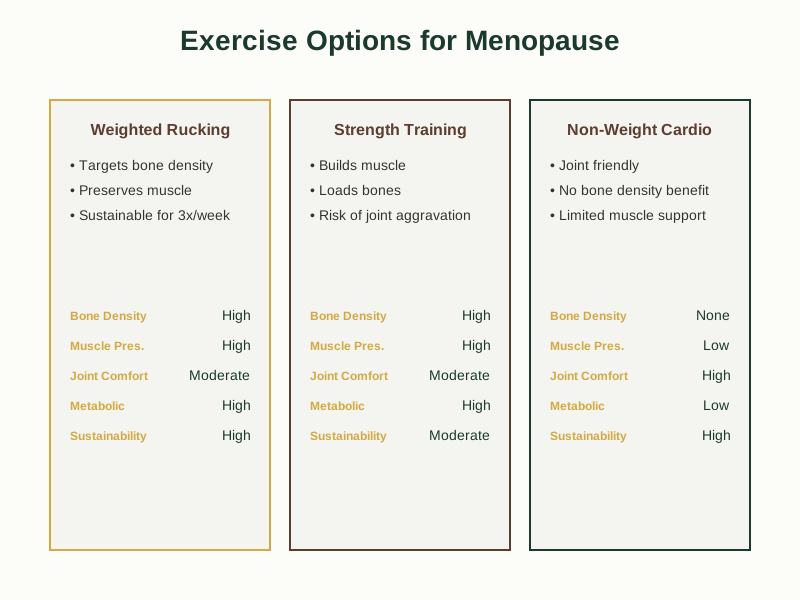
Weighted rucking (walking or hiking with a loaded rucksack or weighted vest) is the only option that simultaneously targets bone density and muscle preservation while also being sustainable enough for most women to do three times a week. It provides direct mechanical loading through the spine and hips, the exact sites where post-menopausal bone loss is most significant. The trade-off is that adding load to your body also adds stress to your joints. If you already have aching knees or hips, a heavy ruck can aggravate that sensitivity rather than resolve it. The key is managing load carefully, which the safety section covers below.
General strength training (free weights, machines, or bodyweight) is excellent for building muscle mass and countering metabolic slowdown. It also loads the bones enough to have a meaningful effect on bone density. The risk is joint aggravation from poor form or loading that progresses too quickly. Without the sustained, rhythmic nature of walking, it also doesn’t provide the same cardiovascular and weight-bearing stimulus that rucking delivers in a single session.
Non-weight-bearing cardio (swimming, cycling, rowing) wins on joint comfort; it’s the right choice if joint pain is your primary limiting factor. But it does nothing for bone density, because your bones aren’t bearing weight. It also doesn’t counteract muscle loss as effectively as resistance-based training. If your knees are in genuinely bad shape, cycling and swimming are better than nothing, but they’re not doing the heavy lifting on bone health.
Here’s the honest summary:
- Bone density: Weighted rucking wins. Strength training is a strong second. Non-weight-bearing cardio doesn’t contribute.
- Muscle and metabolism: Strength training wins. Weighted rucking is a close second. Non-weight-bearing cardio is limited.
- Joint comfort: Non-weight-bearing cardio wins. Strength training and weighted rucking both carry risk if load is poorly managed.
The table below lines the same three options up side by side, with sustainability added as a fourth factor worth weighing alongside the physical ones.
| Benefit | Weighted Rucking | Strength Training | Non-Weight-Bearing Cardio |
|---|---|---|---|
| Bone Density | High | High | None |
| Muscle Preservation | High | High | Low |
| Joint Comfort | Moderate | Moderate | High |
| Metabolic Support | High | High | Low |
| Sustainability | High | Moderate | High |
The Verdict — What Actually Works
The instinct after menopause is often to go gentler, not heavier — swap the gym for the pool, trade the rucksack for a stroll. For joint comfort alone, that instinct holds up fine. For bone density, it’s the wrong call, and getting this particular choice wrong is a lot harder to undo than getting it right is to achieve.
For most women, weighted rucking is the right call — not because it feels safer, but because bone loss is the one job on this list you can’t fully claw back once it’s gone. You can rebuild muscle with consistent training. You can manage joint pain with better fit and smarter load management. Significant bone loss through the spine and hip doesn’t reverse on the same timeline; at that point you’re managing it, not undoing it. The direct mechanical loading rucking delivers, with weight travelling through your spine and hips on every step, is the most effective stimulus available for telling your bones to rebuild rather than just slow their decline.
Strength training is still the better pick for muscle gain and metabolic health taken on its own, and if bone density genuinely isn’t your concern, it may be the more efficient choice. But for most women at this stage, bone density is the job with the least room for error, and weighted rucking does it best while still pulling meaningful weight on the muscle side too.
Flip this call if: you have diagnosed osteoarthritis or significant joint pain that worsens with added load. In that situation, non-weight-bearing cardio or low-impact strength training is the safer starting point. See a GP or physiotherapist before adding weighted training if you have a diagnosed joint condition; they can help you find a safe entry point.
The Royal Osteoporosis Society discusses weight-bearing exercise specifically in the context of post-menopausal bone health, and the NHS recommends it as part of its menopause management guidance. If you have osteopenia, osteoporosis, or a diagnosed bone condition, check with your GP or a physiotherapist before starting weighted training; they can advise on safe load ranges and any modifications you need.
How to Ruck Safely After Menopause
The risk with weighted rucking isn’t the activity itself; it’s adding load before your joints and soft tissues have adapted. Done properly, it’s one of the safest and most effective training tools available. Done badly, it can aggravate exactly the joint pain you’re trying to manage.
Start with 5–10% of your body weight. For a 70kg woman, that’s 3.5–7kg. Start lighter than feels necessary. Many post-menopausal beginners make the mistake of loading up too quickly because they assume the weight needs to be significant to be effective. Your joints and soft tissues need time to adapt to the additional stress. Increase gradually over weeks and months, not days.
Pack fit matters more than brand or price. The shoulder straps, hip belt, and torso length all determine whether the pack sits stable under load or shifts and creates friction points. For post-menopausal women, a properly adjusted hip belt is essential; it transfers weight from the shoulders to the hips, which are better equipped to handle sustained load. If the hip belt sits too high or is missing entirely, the weight concentrates on the shoulders and spine, and that’s where chafing and joint strain become problems. The feedback from UK ruckers is consistent: most hot spots and blisters come from poor pack fit, not from carrying too much weight.
Choose footwear that supports the load. A trail shoe with good grip and stability under load is the safer choice for UK terrain. Soft, cushioned running shoes tend to compress under additional weight, which changes how the shoe feels and can shift the foot inside, creating friction. Trail shoes with a more structured sole and aggressive grip handle the added load better and provide more confidence on wet grass, mud, and canal towpaths.
Socks matter more than people expect. Cotton holds moisture, which softens the skin and dramatically increases blister risk under load. Merino wool or synthetic performance socks wick moisture away and reduce that friction. It’s a small detail that makes a significant difference on longer rucks.
The practical checklist before your first weighted ruck:
- Start with 5–10% of body weight
- Adjust the hip belt before adding any significant load
- Choose trail shoes with structure rather than soft running trainers
- Use merino or performance socks instead of cotton
- Stop if you feel sharp, localised pain; general muscle fatigue is normal, but sharp joint pain is a signal to pause and reassess
Now you know what to look for — Get the Free First Ruck Gear Checklist to make sure your kit is set up correctly before your first session.
Gear Recommendations for the UK
The best gear for post-menopausal rucking isn’t necessarily the most expensive; it’s the most stable under load and the most comfortable over sustained periods.
Rucksacks
The GORUCK GR1 is the standard recommendation for serious ruckers. It’s built like a tank, with a lifetime warranty, bomb-proof construction, and owners who report their pack still functioning perfectly after years of use. The trade-off is price and weight: it’s significantly more expensive than a typical fitness backpack, and the 26L version has no built-in hip belt, which matters for load-carrying. The shoulder straps also need a break-in period.
For a dedicated rucking pack, the GORUCK Rucker (paid link) is purpose-built for exactly this use. It has lumbar support that positions a weight plate close and high on the upper back, and owners consistently cite it as the most stable carry option available. It’s expensive and not designed for everyday carry, but for regular rucking training, it’s worth its salt.
View GORUCK Rucker on Amazon → (paid link)
If budget is a constraint, the Karrimor KSB 3 is the accessible entry point. It’s significantly cheaper than the GORUCK options. But the durability issues are real; sole separation, waterproofing failures, and thin cushioning that causes hot spots on longer walks come up repeatedly in owner feedback. Fine for light, occasional use, but not what you’d choose for regular training.
Weighted plates
The Rogue Ruck Plate is the premium choice. The curvature is specifically designed to sit comfortably against your back without shifting, and owners consistently report it staying stable even during faster-paced rucking. The common complaint is shipping damage; check the product carefully on arrival.
The Mirafit Ruck Plate is the honest budget pick. It does what it should for weighted walking and rucking without the premium price tag, and owners report the fit is solid in most standard plate pockets. The trade-off is a flatter design without the Rogue’s contoured comfort, and occasional cosmetic damage on arrival. For the price, it’s worth trusting; just check it before your first session.
Footwear
The Salomon Speedcross Peak (paid link) is the go-to for UK conditions. It carries the same mud-focused Contagrip outsole family as the rest of the Speedcross line, and the grip on muddy trails, wet grass, and soft ground is exceptional; owners consistently describe it as the best shoe they’ve used for muddy British terrain. It comes out of the box comfortable, which matters when you’re breaking in both a shoe and a new training habit. The trade-offs: it runs warm and doesn’t breathe well, and the fit is narrow; worth trying in person if you have wider feet.
See it on Amazon → (paid link)
The Decathlon Evadict XT7 is the budget option that doesn’t feel like a compromise. It’s comfortable straight out of the box and provides good traction on muddy ground at a fraction of the price of premium trail shoes. The durability concerns are real, with sole delamination after higher mileage appearing in owner feedback, but for a first rucking shoe, it’s a solid starting point.
Socks
Darn Tough Run (paid link) is the premium sock that earns its price through longevity. It’s backed by Darn Tough’s unconditional lifetime guarantee, with strong moisture-wicking and a secure fit that doesn’t slip or roll. Owners consistently describe them as the best hiking and rucking socks they’ve owned. The trade-off is a tighter toe box and a minimalist, low-cushion feel; not plush, but built for performance.
See Darn Tough Run on Amazon → (paid link)
The Decathlon Run Merino Socks are the value option that still delivers on the essentials: warmth, moisture management, and reduced blister risk. The fit inconsistencies are the main caveat; try your size before committing to a full set. For winter rucking, they’re worth having in the kit.
Frequently Asked Questions
Can weighted rucking make my osteoporosis worse?
No; weight-bearing exercise is the primary mechanism for protecting against weakening bones. NHS guidance specifically recommends weight-bearing activity for bone health during and after menopause. Research also shows strength training predicts positive bone change in post-menopausal women. If you have diagnosed osteoarthritis or significant joint pain, check with a GP or physiotherapist before starting weighted training; they can advise on safe load ranges and any modifications you need.
How much weight should I carry?
Start with 5–10% of your body weight. For a 70kg woman, that’s roughly 3.5–7kg. The honest principle is: start lighter than feels necessary and build gradually over weeks and months, not days. Some women can progress quickly; others need more time. Both are fine.
Is a weighted vest or rucksack better?
A vest distributes weight evenly across the torso, which some women find more stable, particularly for faster movement or running-adjacent work. A rucksack with a hip belt can transfer more load onto the hips, which takes pressure off the shoulders and spine. For most beginners, a vest is the simpler starting point because fit is more straightforward. If you’re planning longer rucks and your pack has a proper hip belt, a rucksack becomes the more comfortable option.
What shoes are best for rucking?
Look for trail shoes with good grip and stability under load. The Salomon Speedcross Peak (paid link) handles UK mud well and is comfortable straight out of the box. The Decathlon Evadict XT7 is a budget option that’s comfortable to start with, though durability becomes a question mark with heavy use. Avoid soft, cushioned running shoes; they compress under load and can shift the foot inside the shoe, creating friction and hot spots.
Three Jobs, One Habit
Weighted rucking earns the “right call for most women” verdict because it’s the only one of the three options that shows up for all three jobs at once — bone density, muscle preservation, and metabolic support — inside a single, sustainable habit rather than three separate ones you’d have to keep juggling. The trade-off is real: added load can aggravate joint sensitivity, which is why starting light and getting the fit right matters more than pushing the weight up quickly.
If you have diagnosed osteoarthritis, osteoporosis, or significant joint pain, that changes the calculation — see a GP or physiotherapist before adding weighted training to your routine, and treat this article as background reading rather than a substitute for that conversation. The Royal Osteoporosis Society covers exercise and bone health in detail, the NHS sets out weight-bearing activity as part of its menopause management guidance, and Menopause Matters is a useful independent resource for the wider symptom picture — all three are worth reading alongside whatever your GP tells you about your own bones.
The honest answer is that weighted rucking asks for a bit more planning and a bit more upfront investment than a regular walk. The bone density and muscle preservation payoff is real and well-supported, and it’s worth the effort. Start light, build gradually, get the fit right — that’s the whole game, and every part of it is doable. For the fuller picture on what UK guidance actually recommends for bone-focused training, see What UK Guidance Says About Weighted Training for Bone Density.
Ready to get started safely? Get the Free First Ruck Gear Checklist — it covers pack fit, weight selection, footwear, and socks so nothing gets missed before your first session.
As an Amazon Associate we earn from qualifying purchases. The products linked above are ones we recommend based on independent research and owner feedback.