Can Your Running Shoes Survive 50 Miles with a Pack?
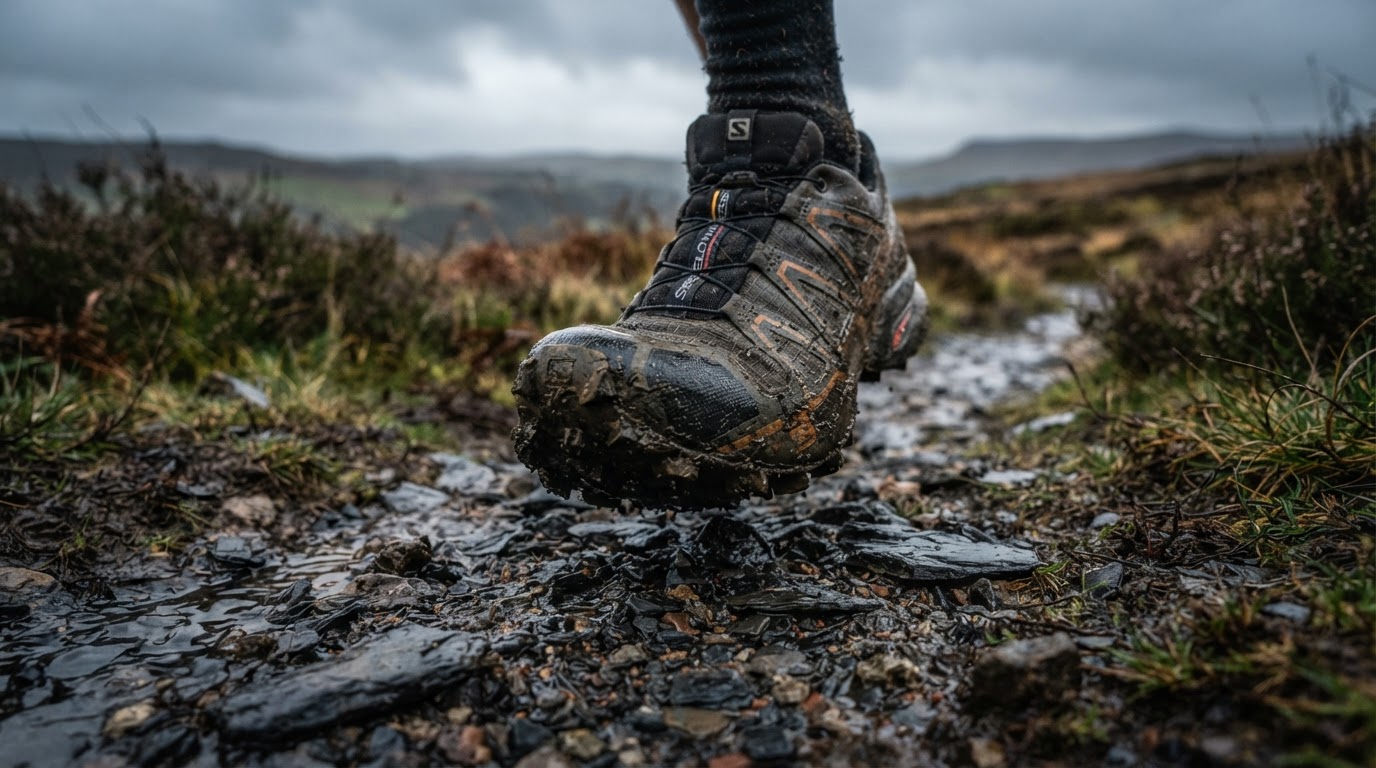
Most rucking gear failures don’t come from a bad shoe. They come from a good shoe being asked to do a job it was never built for. A running shoe is engineered around one variable — your bodyweight, bouncing along pavement — and rucking changes that variable the moment you strap on a pack. Add 15kg and ask the same shoe to hold up for 20 miles of wet UK coastal path, and the mismatch shows up as hot spots by mile 10, aching knees by mile 20, and a midsole that’s noticeably flatter than it was in week one.
The instinct is to blame the shoe. It’s usually the wrong target — most of the shoes people reach for first are genuinely decent running shoes. They just weren’t specified for load.
This isn’t about brand names or price tags. It’s about understanding what a rucking shoe actually needs to do — and why the shoes most people grab first often fail the load faster than they’d like.
The Three Jobs of a Rucking Shoe
Before you look at any specific model, it helps to know what you’re actually buying into. A shoe that survives a 5K run can still fail a ruck, because rucking puts three distinct demands on footwear that bodyweight running simply doesn’t.
📺 Watch: The ONE Tip You Need to Choose Between Hiking Boots, Shoes, and Trail Runners — Meg in the Forest
Job 1: Traction on varied terrain. UK walking and rucking terrain is rarely one thing. You’ll move from wet pavement to muddy trail to grass to rock in the space of a few miles. A shoe with decent lug depth and a grippy outsole compound handles that transition without turning every downhill into a controlled slide. Road-running shoes with shallow treads are the weak link here — fine for dry pavement, sketchy the moment the path turns damp and rutted.
Job 2: Durability under sustained load. The midsole is where most shoes die for ruckers. Foam compresses under repeated stress, and adding 15–20kg of pack weight accelerates that compression beyond what the manufacturer tested for. A shoe that feels springy at mile 5 can feel flat and unforgiving at mile 15. The structural integrity of the midsole — how it holds up under sustained compressive load — is the difference between a shoe that lasts 50 miles and one that quits at 30.
Job 3: Friction management at the foot-shoe interface. This is where most ruckers focus entirely on the shoe and miss the real problem. Blisters aren’t caused by shoes — they’re caused by friction between your skin and whatever’s next to it. A shoe can fit perfectly unloaded and still create hotspots once 15kg shifts your gait and your foot swells under sustained effort. The shoe matters, but it’s only half the equation.
As a practical checklist: look for a trail-rated outsole, a midsole with decent stack height but firm enough not to collapse under load, and an upper that breathes without holding moisture. The shoe handles Jobs 1 and 2. Job 3 requires a separate solution — which we’ll come to.
If you’re building out your kit and want a more complete view of what to check, our rucking gear checklist covers the shoe alongside the pack, socks, and other essentials that affect whether your feet survive a long ruck.
The Cushioning Split That Actually Matters
The split that matters most when you’re choosing a shoe for load-bearing work isn’t the one most running shoe marketing pushes you toward — and it’s not really “air vs foam” either, whatever the shoe wall labels suggest. Almost everything on the market is some form of EVA or EVA-blend foam; the real difference is how soft and bouncy that foam is formulated to feel.
Soft, high-rebound foam — the compression-molded EVA in shoes like the Hoka Clifton, and the nitrogen-infused foam blends Brooks runs through most of its maximal-cushion range — is tuned for repeated bodyweight impact. It’s built to compress easily and spring back under your weight alone, which is what gives those shoes their plush, “cloud-like” feel. Add a 15–20kg pack, and you’re pushing that formulation beyond its design range. The compressive stress increases, the foam’s cell structure fatigues faster, and the midsole starts to lose its rebound. Wearers of these shoes on long rucks often describe the cushioning going “dead” after 20–30 miles — plush at the start of a session, flat and harsh by the end.
Firmer, denser midsole compounds — EVA, PEBA, or newer polymer blends found in trail-specific shoes from Salomon, La Sportiva, Inov-8, and Altra — compress more predictably under load. They don’t have the same initial “cloud” feel, but they maintain their structure longer. What you give up is comfort: you’ll feel more of the ground, especially on harder surfaces like UK pavements and canal towpaths.
For most ruckers, the durability advantage of a firmer midsole outweighs the comfort loss. You’re not running a PB — you’re carrying weight over distance. The shoe that feels slightly less cushioned at mile 5 but still has structure at mile 40 is the better tool.
The exception: if your rucks are consistently short (under 5 miles), lighter (under 10kg), and mostly on softer trail rather than concrete, a soft-cushioned road shoe will serve you well enough. The failure mode we’re describing is load-dependent — the heavier and longer, the more a firmer midsole pulls ahead.
For a full comparison of how trail shoes stack up against boots for rucking specifically, see our trail shoes vs road shoes guide.
The Hidden Failure Mode: Cushioning vs. Load
This is the bit that most shoe reviews miss, because most shoe reviewers aren’t loading the shoes.
Soft, high-rebound foam compresses and springs back — that’s the mechanism that gives maximal-cushion shoes their signature plush ride, and it’s genuinely well-engineered for absorbing repeated, moderate impact. But that formulation has limits. When you add 15–20kg of pack weight on top of your bodyweight, the effective load on the foam’s cell structure increases significantly. The rebound becomes incomplete. The cells lose some of their ability to spring back to shape. Over successive miles, this manifests as a progressive loss of shock absorption — the shoe that felt bouncy at the start of a ruck feels progressively harder as the miles accumulate.
Firmer, denser trail-shoe midsoles don’t have this failure mode in the same way. They compress under load and recover, but the compression is more distributed and predictable. A firmer midsole might feel harder from the first step, but it maintains that feel more consistently over distance. The performance curve is flatter.
The result on a long ruck: a shoe built around soft, max-cushion foam can leave you with hot spots and joint discomfort that don’t match the distance you’ve covered. The midsole has effectively given up before your feet have. It’s why ruckers who switch from soft-cushioned road shoes to firmer trail shoes for rucking tend to report fewer midsole-collapse issues and less joint fatigue at the end of a heavy session.
The practical implication: if you’re using a shoe primarily for rucking and you notice your feet and knees feeling progressively more beat up as a session goes on — not at the start, but as the miles accumulate — the midsole is likely the culprit. It’s not necessarily a bad shoe for its intended purpose. It’s just being asked to do something its cushioning system wasn’t built for.
The Sock Factor (The Real Blister Preventer)
Here’s the uncomfortable truth: the shoe gets too much credit for blister prevention and too much blame for blister causation. The actual friction point is the interface between your skin and your sock. A shoe that fits perfectly unloaded can still create hotspots once your foot flattens and lengthens slightly under load — and once moisture enters the equation, the friction coefficient changes dramatically.
📺 Watch: Foot taping - Blister prevention for Ultra running — RunUltra UK
Standard socks — cotton, most synthetics, even single-layer technical socks — move against your skin as you walk. The foot slides slightly inside the shoe. Shear forces build at the interface. That shear, sustained over miles, is what creates a blister.
Double-layer socks break that cycle. The Wrightsock system — which uses an inner layer that moves with your skin and an outer layer that moves with the shoe, with friction absorbed between the two layers rather than against your skin — is the solution most rucking and hiking communities land on first. The design means your skin stays relatively stable while the outer layer handles the movement.
The pattern people describe after switching is consistent: blisters that reliably showed up at mile 15–20 without double-layer socks simply stop appearing once they switch. Wrightsock markets its own products as having been “worn on 462-mile trails” and “26.2-mile marathons,” which gives a sense of the distance range they’re built to survive.
For a one-off heavy event, Wrightsocks are almost always worth the investment. For regular rucking, they’re arguably the single highest-ROI piece of kit you can add — cheaper than a new pair of shoes, more effective at solving the actual problem.
If you’re serious about preventing blisters on longer rucks, our full blister prevention for rucking guide covers socks, lubes, taping techniques, and shoe fit adjustments in more detail.
UK-Specific Terrain and Shoe Recommendations
UK rucking terrain is a mixed bag, and your shoe needs to handle it. Muddy coastal paths, wet grass, canal towpaths (often compacted stone with occasional puddles), and the brutal reality of a wet winter trail that hasn’t drained properly in weeks. Road running shoes that work fine in summer can become genuinely dangerous in winter UK conditions.
📺 Watch: How to Hike & Wild Camp the Gower Peninsula Coast Path — Matt Walk Wild
Salomon — particularly the Speedcross series — has built its reputation on grip in mud and wet grass. The aggressive lug pattern cuts through surface mud rather than floating on top of it. The Salomon Speedcross Peak (paid link) comes up most often for rucking — genuinely impressive grip on wet mud and grass. The trade-off is that they run warm: on a summer ruck or a hard effort, breathability becomes an issue. The GTX (Gore-Tex) versions hold moisture in longer once it’s got past the collar than the non-waterproof variants do, which matters when you’re rucking through wet grass for 15 miles.
See Salomon Speedcross Peak on Amazon → (paid link)
La Sportiva — models like the Bushido and the Spire — offer a good balance of trail grip, durability, and a slightly more refined feel than the mud-spike focus of Salomon. They tend to hold up over higher mileage better than trail shoes that sacrifice durability for cushioning.
Inov-8 — particularly the Trailfly and Terraultra lines — use Graphene-Grip rubber outsoles, developed with graphene researchers at the University of Manchester and lab-tested at over 50% more wear-resistant than the brand’s older rubber compounds. The grip on wet rock and muddy trail is strong. Where they give ground back is stack height: Inov-8 shoes tend toward a lower, firmer ride that some ruckers find too minimal for heavy loads on hard surfaces.
Hoka — the Speedgoat is the most commonly cited Hoka for trail work, and the cushioning is genuinely plush. Under load, it remains comfortable. The issue in UK conditions is mud: the outsole pattern doesn’t evacuate mud as well as Salomon’s, and on a genuinely wet, muddy coastal path, the lugs can pack up and confidence on descents drops.
Merrell Moab — the Moab 2 and Moab 3 are frequently cited as the honest budget option. Comfortable out of the box, roomy fit, and a price point that doesn’t require justification. The Merrell Moab 3 GTX (paid link) fits that description well, with Gore-Tex waterproofing on top. Grip on wet rock and wet ground is where they fall short, and it’s the one criticism that comes up again and again in reviews of both models. For light to moderate loads on well-drained paths, they’re a solid choice. For heavy loads on genuinely wet, muddy terrain, look higher.
Buy Merrell Moab 3 GTX on Amazon → (paid link)
A useful working estimate: expect a shorter lifespan for rucking than the 300–500 miles usually quoted for standard, unloaded running shoes. There’s no dedicated study on loaded-mile mileage, but loaded miles compress the midsole faster, so treat the top of that range as optimistic once you’re regularly carrying 15kg or more. The midsole degradation isn’t always visible, but the loss of shock absorption and support is real — and the joint stress that comes from a collapsed midsole is cumulative.
Frequently Asked Questions
Can I use my current running shoes for rucking?
Yes — for short distances and light loads, standard running shoes will serve you well enough. The problem comes when loads get heavier or distances longer. The soft, high-rebound foam common in cushioned running shoes tends to compress and lose structure faster under sustained rucking load than the firmer, denser midsoles built into trail-specific shoes. If you’re regularly rucking over 10 miles with 15kg or more, you’ll likely notice the difference — and the shoes will tell you through hotspots, midsole fatigue, and joint discomfort.
Do I need hiking boots for rucking?
Not necessarily. Hiking shoes — particularly trail-rated models with decent ankle support and sturdy midsoles — are often sufficient for day rucks. Boots make more sense for heavier loads, rougher terrain, or if you’re carrying for extended periods and want more ankle stability. For most UK ruckers doing mixed terrain at moderate loads, a good trail shoe with a foam midsole will outperform a heavy boot that hasn’t been broken in properly.
How often should I replace my rucking shoes?
There’s no dedicated mileage study for rucking specifically, so treat this as an estimate rather than a measured figure: standard running shoes are generally good for 300–500 miles of unloaded use, and loaded miles compress the midsole faster, so the real number for regular rucking is likely lower than that range. The midsole degradation isn’t always visible from the outside — the shoe can look fine while the cushioning has lost its structure. If you notice your knees or feet feeling progressively worse as a ruck goes on, or if the ride feels noticeably harder than it did when the shoes were new, it’s time to replace them regardless of what the upper looks like.
Are double-layer socks worth it?
Yes — genuinely. For blister prevention under load, the double-layer system (like Wrightsocks) addresses the actual mechanism of blister formation: friction between skin and sock. Standard socks move against your skin as you walk; double-layer socks absorb that movement between the two layers, keeping your skin relatively stable. People who switch usually notice the difference straight away, particularly on longer rucks or events.
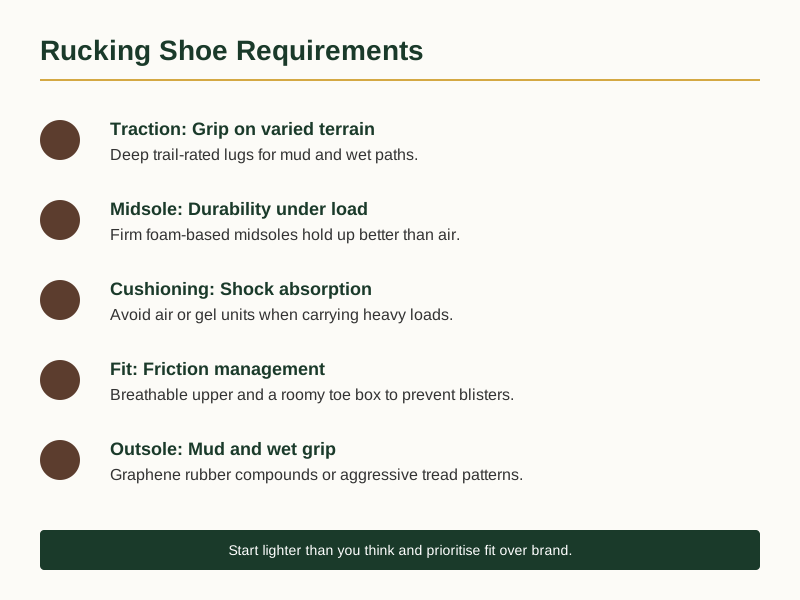
Rucking Shoe Key Features
| Feature | Why It Matters | What to Look For |
|---|---|---|
| Traction | Grip on varied UK terrain | Trail-rated outsole, deep lugs |
| Midsole | Durability under load | Foam-based (EVA/PEBA), firm feel |
| Cushioning | Shock absorption | Avoid soft max-cushion foam for heavy loads |
| Fit | Friction management | Breathable upper, roomy toe box |
| Outsole | Mud and wet grip | Graphene rubber or aggressive lugs |
Taking the Next Step
The core call is straightforward: for rucking specifically, prioritising a firmer, denser midsole over soft, plush cushioning gives you better durability under load, even if the initial ride feels less forgiving. The shoe handles traction and structure — but blister prevention comes from managing friction at the skin-sock interface, which means double-layer socks are worth factoring in regardless of which shoe you choose.
UK terrain does a lot of the deciding for you, if you let it rule things out rather than trying to find one perfect shoe. Cross Hoka off the list if a genuinely muddy coastal path is a regular feature on your routes — the outsole doesn’t clear mud well enough. Cross Inov-8 off if you’re carrying heavy loads on hard, flat ground — the low stack height that makes it grippy on rock gets uncomfortable fast under weight. Cross the Merrell Moab off if wet rock scrambling is part of the route — it’s the honest budget pick everywhere else, but that’s the one condition it doesn’t handle. What survives those cuts — Salomon for pure mud, La Sportiva for a more refined all-rounder — is a short list to choose between, not a single universal winner.
Now you know what to look for in a rucking shoe — and why the shoes most people reach for first often fail faster than expected. If you’re building out your kit or auditing what you’ve already got, the Free First Ruck Gear Checklist covers the shoe alongside the pack, socks, and everything else that determines whether your feet survive a long ruck.
Grab the checklist and work through it before your next session. Your feet will thank you for it.
Keep Reading
For the fuller picture on fit, sizing and the boot-vs-shoe decision, see our Best Shoes for Rucking in the UK: What Actually Survives 20kg Loads guide. And if you want to check current models, sizing or pricing directly, these are the brand pages referenced above: