Rucking in the UK: Terrain, Weather, and Event Guide
As an Amazon Associate we earn from qualifying purchases. Some links on this page are affiliate links, which means we may earn a small commission if you make a purchase.
Terrain, weather and event demands rarely show up in isolation on a British ruck. A gravel path that’s firm and forgiving in April becomes a different problem entirely in November — same 15kg, same shoes, but now mud changes your footing, cold stiffens your grip on the straps, and if there’s a time limit involved, every extra minute spent picking a line through the mud is a minute you don’t get back. Most rucking advice treats gear, weather and fitness as separate chapters. On UK ground they rarely behave that way: get the terrain read wrong and the weather punishes you harder for it; get the weather kit wrong and the pack starts sliding within the hour.
That compounding effect, not a lack of fitness, is what actually stops people. Nobody quits a ruck because they can’t carry 15kg — they stop because the terrain changed their gait, the cold set into wet feet, and the pack that felt fine on a dry test walk started rubbing raw an hour into the real thing. This guide treats terrain, weather and events as the single interacting system they are for UK adults adding load to their walks, not three separate topics bolted together.
The UK Rucking Reality: Mud, Rain, and Hills
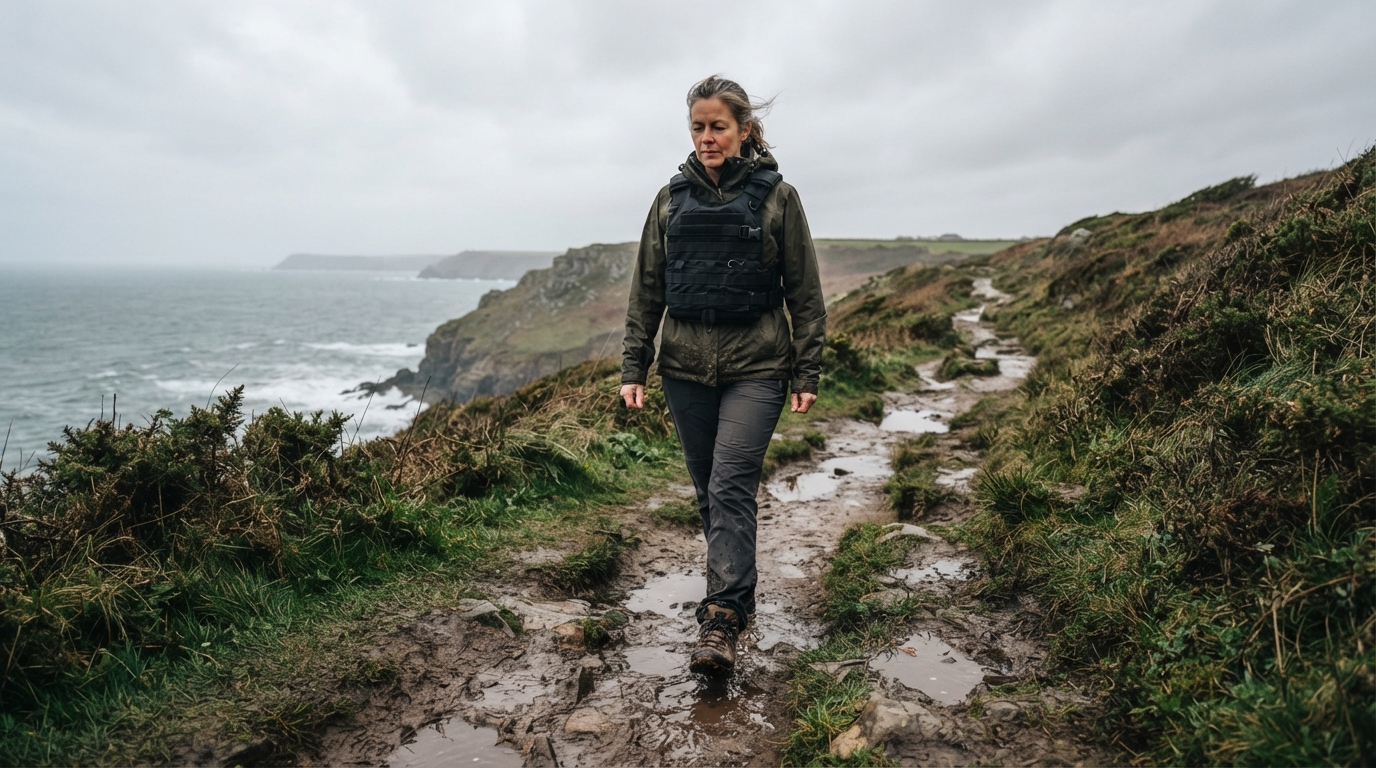
UK rucking is defined by conditions that would make a US influencer put their phone away. Mud, rain, cold wind, steep hills, and the particular joy of stop-start urban terrain where you are dodging traffic one minute and squelching through a farm gate the next. The “loaded march” format common in UK events — steep ascents, tight time limits, basic navigation — compounds this. Wasdale Mountain Rescue Team regularly posts warnings about heavy rainfall and river crossings on Scafell Pike through the winter months, and they are not posting for fun. The terrain that defines much of UK rucking is genuinely demanding in ways that pavement-based fitness walking simply is not.
Practical success comes down to layering, traction, and pack stability, not brute strength. A strong person with a slipping pack and wet socks will always lose to a prepared person with a stable load and dry feet. That is the honest answer to why so many people start rucking and stop after a few sessions. It is not the weight that defeats them; it is the friction, the cold, and the chafing that nobody warned them about.
One pattern that comes up repeatedly in owner feedback: a ruck that feels perfectly manageable on pavement becomes genuinely miserable on a muddy trail, even at the same weight. The mechanism is straightforward — muddy or icy footing changes your gait, which changes where pressure builds in your shoes, which is exactly where blisters start. The terrain is not a backdrop; it is a variable that changes every other decision you make.
If you are new to the concept, our Honest Beginner’s Guide to Rucking in the UK covers the fundamentals. But for UK conditions specifically, read on.
Gear & Load-Carrying Mechanics: Fit, Rubbing, and Wet-Weather Management
The primary failure modes in UK rucking are not strength-related; they are friction-related. Moisture-wicking layers and anti-chafe measures are the first line of defence — a non-negotiable for anything over 90 minutes. When your base layer holds sweat against your skin and you add a rucksack strap pressing into that damp zone, you are building the exact conditions for a raw shoulder seam. Repeat that across three hours and rain, and you are done.
📺 Watch: Backpack Straps Explained - Hiking Tips — Set To Hike
The wet-weather kit list is short but essential: a waterproof shell that seals at the wrists and neck, spare socks in a dry compartment (not at the bottom of the pack where they will compress into a damp brick), and anti-chafe balm applied before you set off, not when you notice the hot spot. Body Glide and Squirrel’s Nut Butter are the names that come up most in UK rucker circles — applied to shoulders, under-band areas, and the inner thigh crease where longer rucks bite hardest.
The technique layer matters too. Walk upright with short strides. Leaning forward under load is a common mistake that shifts weight onto your shoulders instead of your hips, and it compresses your lower back on descents. Select terrain that matches the session goal: if you are working on endurance, stick to trails you know. If you are building technical confidence, accept that a muddy descent will be slower and harder than a dry one. That is not a gear failure; it is terrain doing what terrain does.
Muddy or icy footing can matter as much as footwear type. A shoe that grips brilliantly in dry trail conditions can still leave you sliding on a wet grass slope. The interaction between your outsole, the terrain, and your load is complex enough that no single shoe solves it — which brings us to the footwear section.
Footwear: Grip, Comfort, and Durability in Mixed Terrain
Footwear is where UK rucking decisions get specific, and where the trade-offs between brands are real and consequential. Here is how the main options stack up.
Inov-8 Trailfly G 270 (paid link) — the standout for durability and ground feel. Owners consistently report exceptional grip on wet rock and hard-packed trail, with the Graphene-enhanced outsole delivering longevity that justifies the price. Several long-term owners report the outsole comfortably outlasting the rest of the shoe, with 500+ miles logged before any real breakdown — the kind of durability figure that matters when you are comparing cost-per-wear. The 0mm drop and firm stack height are not for everyone — if you are used to a plush, cushioned trainer, this will feel harsh. The toe box is roomy, which helps on long descents, but the midfoot and heel can feel less secure than the forefoot. Mud can build up in the lugs, which is worth cleaning out on longer routes. For neutral trail runners or fast hikers who want stability and ground feel over cushioning, this is the honest pick. Budget alternative: the Decathlon Evadict XT6 is functional and durable for the price, but it is a compromise on comfort, grip, and responsiveness — fine for occasional use, not ideal if you are rucking regularly.
See current price on Amazon → (paid link)
Salomon Speedcross Peak (paid link) — the mud specialist. It carries the same Contagrip lug lineage as the wider Speedcross family, and the aggressive lug pattern bites into soft ground and wet fields in a way that most trail shoes cannot match. It comes comfortable out of the box, which matters when you are buying online and cannot test the fit. The trade-offs are the ones you’d expect from any deep-lug mud shoe: it runs warm and does not drain well, so your feet stay damp even after stream crossings, and on firm ground the aggressive tread can feel tippy compared with a flatter outsole. If your regular routes are soft, muddy trails, this is worth living with. Budget alternative: the Decathlon Evadict XT7 is comfortable and offers decent mud grip for the price, but struggles on technical descents and lacks the stability of the Speedcross Peak.
View Salomon Speedcross Peak on Amazon → (paid link)
Merrell Speed Strike 2 GORE-TEX (paid link) — lighter and more technical than the classic Merrell hiker, built for speed over the roomy comfort Merrell is best known for. The GORE-TEX membrane keeps water out through stream crossings and wet grass, and the sticky outsole with deeper heel and forefoot lugs holds on wet rock better than a standard trail-shoe compound. Owners report solid all-day comfort despite the lower-profile build. The trade-off against a traditional Moab-style hiker is fit — it runs narrower and less forgiving, so it suits a faster, lighter-loaded ruck better than it suits someone wanting maximum room for a swollen foot on a long carry. Budget alternative: the Karrimor KSB 3 is extremely cheap and adequate for light casual walking, but the durability issues — soles detaching, waterproofing failing, thin cushioning causing blisters — make it a poor choice for regular rucking.
Buy Merrell Speed Strike 2 GORE-TEX on Amazon → (paid link)
Hoka Speedgoat 5 — the cushioned comfort option. The plush ride and secure trail grip make it popular for long runs and mixed terrain, and the true-to-size fit works for most buyers. The toe box can feel too wide or the shoe too small in length — fit inconsistency is the main complaint. In very muddy conditions, the lug pattern struggles compared to the Speedcross. The cushioning is excellent for long days, but if you are moving fast and need ground feel, it can feel disconnected. Budget alternative: the Decathlon Evadict XT6 again, with the same caveats — functional for the price, a compromise on performance.
The trade-off summary across these options: the Trailfly G 270 wins on ground feel and durability; the Speedcross Peak wins on mud traction; the Speedgoat wins on all-day comfort; the Speed Strike 2 GORE-TEX wins on speed and wet-weather protection in a lighter package. For most UK ruckers carrying load on mixed terrain, the Trailfly G 270 is the default worth paying for — but if your routes are consistently muddy, the Speedcross Peak earns its place.
Rucksacks & Plates: Stability and Durability
Load stability matters more than most buyers realise before their first proper ruck. A pack that shifts under load does not just feel uncomfortable; it changes your gait, which changes where pressure builds in your feet and knees. The rucksack and plate choice is where that stability either gets built in or gets compromised.
GORUCK GR1 — the benchmark for durability. The bomb-proof construction comes up in virtually every conversation about rucking packs, and the materials and craftsmanship genuinely justify the premium price for buyers who want a “buy-it-for-life” purchase. After years of use, owners report zippers remaining in great shape and the bag not sagging — that is the kind of long-term evidence that matters when you are comparing price points. The shoulder straps can feel stiff during the break-in period, which is worth knowing before you set off on a long ruck. The trade-off is basic features — no built-in waist belt, no water-bottle pockets, and the front/laptop pockets can be hard to access when the bag is packed full. For buyers who want toughness over organisation, it is the right call. Budget alternative: the Snugpak Response Pack is a sturdy hip pack rather than a general-purpose bag — useful for bushcraft and day-kit carry, but not a direct replacement for the GR1’s capacity or versatility.
GORUCK Rucker (paid link) — purpose-built for rucking with a plate. The plate sits close and high on the back, which creates a stable, ergonomic carry that owners consistently praise. The durability is exceptional, and once broken in, the comfort is solid. The price is high, and it is not an everyday backpack — the purpose-built design shows in the limited versatility. For regular ruckers who want a dedicated training pack, it is worth the investment. Budget alternative: the Karrimor SF Predator 30 is a modular trekking daypack with a sturdy build and comfortable carry, but it is not purpose-built for rucking — the 30L capacity is tight for anything beyond day use, and the stitching is not as refined as premium rivals.
See GORUCK Rucker on Amazon → (paid link)
Rogue Ruck Plate — good fit and premium feel. The curvature helps it sit well in standard plate pockets without moving during runs, which is the core job. The complaints that come up most are shipping damage (packaging is not always robust) and the importance of getting sizing right — an off-size plate will jostle, which defeats the purpose. Budget alternative: the Mirafit Ruck Plate offers good value and accurate weight, but the flat design lacks the Rogue’s contour comfort, and cosmetic damage on arrival shows up in buyer feedback.
Yes4All Ruck Plate — the budget option with real limitations. The price is roughly half that of premium brands, and some buyers report it fitting GORUCK-style long pockets well. The fit is inconsistent — it does not sit well in standard ruck plate pockets — and the coating can look and feel cheap, with chipping over time. There is no reliable budget alternative under £50 that preserves the core function — this is one case where saving money genuinely costs you something.
The trade-off summary: the GR1 trades basic features and a high price for exceptional durability; the Rucker is purpose-built for dedicated ruckers; the Rogue wins on fit and feel; the Yes4All is the honest budget pick with real compromises.
Socks: Moisture Management and Durability
Socks are the component most beginners underinvest in, and the one where the cost-per-wear calculation strongly favours quality. Wet, compressed cotton socks are a blister factory — not a discomfort, a mechanical failure of the friction management system between your foot and your shoe.
Darn Tough Vertex — the durability leader. Owners consistently report getting 500+ miles without the socks degrading, which is the figure that matters when you are comparing against cheaper options that might last a season. The moisture-wicking is strong, the fit is snug without slipping or rolling, and they keep feet warm in cold conditions. The toe area can feel tight, and the minimalist cushioning is not for everyone — if you want a plush ride, look elsewhere. The price premium is real, but for regular ruckers, the cost-per-wear works out favourably. Budget alternative: Regatta Merino Wool Socks are comfortable and regulate temperature well for the price, but sizing inconsistencies and delivery issues show up in buyer feedback enough to mention.
Smartwool PhD Run — the comfort and breathability option. The “foot-hugging” feel and breathable construction keep feet dry in variable conditions, and the lightweight, low-bulk design works well in warmer weather. The durability concerns are the main issue — critical reviews consistently flag this, and at the price point, it is a real consideration. The fit can feel tight for wider feet, which is worth checking before buying. Budget alternative: Decathlon Run Merino Socks offer warmth and reduced chafing protection for cold-weather activities, but sizing issues and a high cuff that causes pressure spots show up in buyer feedback.
For regular ruckers, the Darn Tough Vertex is the pick — the durability premium earns back over time, and the moisture management genuinely prevents the blister cascade that stops sessions early.
Event Preparation: Terrain, Weather, and Load
UK rucking events add a layer of specificity that training alone does not prepare you for. Time limits, navigation, and terrain that can change dramatically with weather make event preparation different from just “carry more weight for longer.”
The Fan Dance is the event that defines UK rucking fitness. It is a 24-kilometre out-and-back route over Pen y Fan in Bannau Brycheiniog (Brecon Beacons) National Park — the mountain that has been used as a Special Forces selection course for decades. The official time cutoff for the standard course is 4 hours and 10 minutes, which sounds achievable until you are carrying load up a wet ascent in 8°C and your pack is sliding. The terrain demands both physical endurance and route-finding ability — it is not just a fitness test, it is a systems test.
What separates successful event finishers from those who pull out is not raw strength. It is preparation for the specific conditions: kit that stays stable under fatigue, nutrition that sustains output over the duration, and weather contingency planning that does not leave you hypothermic if conditions turn. A 10-week Fan Dance Training Plan built specifically for that terrain and time cutoff is worth considering if you are targeting the event — generic fitness programmes do not account for the specific load-to-terrain interaction that makes the Fan Dance hard.
UK events in general share common characteristics: steep ascents and descents, variable trail conditions, and time pressure that changes decision-making under fatigue. Training for them means replicating those conditions, not just adding weight to your daily walk.
Frequently Asked Questions
What’s the best footwear for wet UK trails?
For wet, muddy trails, the Salomon Speedcross Peak (paid link) offers superior grip — the aggressive lug pattern bites into soft ground in a way most trail shoes cannot match. The trade-off is warmth and breathability; your feet stay damp even after stream crossings. For mixed terrain where ground feel and durability matter more than mud-specific traction, the Inov-8 Trailfly G 270 (paid link) is the stronger all-rounder.
How do I prevent chafing during long rucks in the rain?
Apply anti-chafe balm before you set off — to shoulders, under-band areas, and the inner thigh crease. Use moisture-wicking layers, not cotton. Carry spare socks in a dry compartment and swap them at the first sign of saturation. Walk upright with short strides to reduce friction points. These are not optional extras for multi-hour sessions — they are the difference between finishing and calling it early.
Is a GORUCK GR1 worth the high price?
If you want a “buy-it-for-life” pack and you are willing to pay for toughness over features, yes. The durability evidence from long-term owners is strong — zippers staying functional, no sagging, materials that survive years of hard use. If you need a versatile everyday bag with better organisation and a built-in waist belt, the price premium does not make sense. For dedicated ruckers, the maths work out.
UK Rucking Gear Comparison
| Category | Best Overall | Best Budget | Key Trade-off |
|---|---|---|---|
| Footwear | Inov-8 Trailfly G 270 (paid link) | Decathlon Evadict XT6 | Comfort vs. Durability |
| Rucksack | GORUCK GR1 | Snugpak Response Pack | Features vs. Toughness |
| Plate | Rogue Ruck Plate | Yes4All Ruck Plate | Fit vs. Cost |
| Socks | Darn Tough Vertex | Regatta Merino Wool | Durability vs. Comfort |
Prepare for the System, Not the Checklist
UK rucking success comes down to managing conditions and mechanics, not just building fitness. The right gear — a stable pack, grippy footwear, moisture-wicking layers, and anti-chafe measures — prevents the failures that stop most people in their first few sessions. Terrain, weather and events will keep doing what they do in Britain regardless of how fit you are; what changes the outcome is whether your kit and route choices account for all three together, not just the one you happened to plan around.
You now know what to look for. The next step is making sure you have actually got it before you load up.
Get the Free First Ruck Gear Checklist to make sure you have got the essentials sorted — the kit that actually survives British conditions, not just the gear that looks the part.
Go deeper on the piece of this that applies to you: How to Ruck in UK Weather (Without Getting Soaked), Can Your Ruck Gear Survive UK Seafronts?, Trail Rucking in the UK: Where to Go and What to Carry, How to Stay Warm Rucking in Winter (Without Overheating), and How to Choose a UK Rucking Event (Without the Gear Stress).
For the weather and event detail above: Wasdale Mountain Rescue Team publish live incident and weather updates covering Scafell Pike and the wider Lake District; Bannau Brycheiniog (Brecon Beacons) National Park Authority covers access and conditions around Pen y Fan; background on the Fan Dance itself is on Wikipedia.
As an Amazon Associate we earn from qualifying purchases. The products linked above are ones we recommend based on independent research and owner feedback.