Impact vs Load: Which Is Better for Bone Strength?

Sarah is 52, based in South East England, and has been told she has osteopenia. She wants to do something active about it, but every time she looks into exercise for bone density, she hits the same wall: running and jumping are supposedly the gold standard, but her knees twinge just thinking about it. She sees people on social media walking with weighted vests—rucking—and wonders if that is the right call for her, or whether she is missing out by avoiding impact.
That tension—between what the research says works and what your body can actually tolerate—is exactly what this article is about. The honest answer is that neither impact nor load training is automatically “better” for everyone, and the reason why matters more than most articles will tell you.
What the NHS Actually Says About Bone Loading
The NHS position on bone health and exercise is worth starting with because it cuts through the noise. Their osteoporosis prevention guidance groups bone-strengthening activity into two broad categories: weight-bearing exercise (activities where you support your own body weight, like walking, running, or dancing) and resistance exercise (activities that work your muscles against a force, like lifting weights or carrying load).
The NHS does not rank one above the other for the general population. Both types of exercise are important for maintaining and improving bone density, and a mix of the two is generally recommended for adults.
The UK’s “Strong, Steady & Straight” consensus statement—published in 2022 and signed off by professional bodies including the British Geriatrics Society—takes a similar line. It frames both impact-type and load-type exercise as legitimate components of bone-strengthening activity, while noting that anyone with a diagnosed bone condition (osteoporosis or osteopenia) should seek individualised guidance from their GP, a physiotherapist, or the Royal Osteoporosis Society before choosing between them.
That last point is the one most articles skip over. The guidance is designed for the general population. If you have been diagnosed with osteopenia or osteoporosis, the question of which exercise is safest for your specific situation isn’t a gear question—it’s a clinical one, and it is worth having that conversation before you start.
The Mechanic of Impact: Brief, High Forces
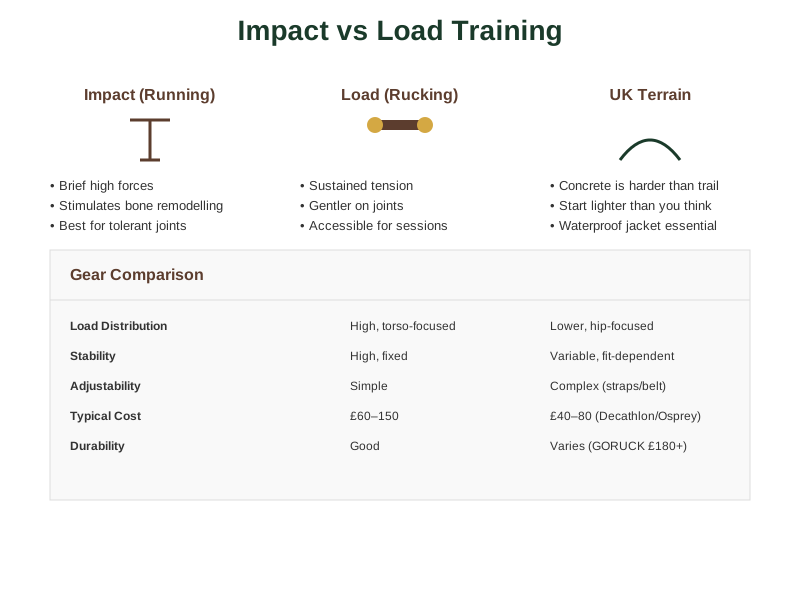
Impact exercise works on bone through a specific mechanical mechanism: every time your foot hits the ground during a run, a jump, or a hop, your body generates a brief, high-magnitude ground-reaction force that travels up through your skeleton. Think of it like a hammer striking a nail—the force is concentrated and short-lived, but it is enough to send a strong signal to the bone cells that they need to lay down more material.
The NHS physical activity guidelines for children and young people describe this well: activities like running, skipping, and jumping help strengthen muscles, ligaments, and joints as well as bones. The key word is “brief”—the force peaks quickly and dissipates quickly, which is why impact is effective at stimulating bone remodelling. It is a high-intensity, short-duration stimulus.
For someone whose joints can handle it, this is a genuinely effective mechanism. The bone responds to that sharp, sudden loading by becoming denser over time. The problem is that “someone whose joints can handle it” is a narrower group than the fitness industry often admits. Runners with knee issues, people with a history of ankle sprains, or anyone with existing joint pain—for them, the mechanical benefit of impact comes with a mechanical cost.
The Mechanic of Load: Sustained Tension
Resistance exercise—and this is where rucking and weighted vests sit—works through a different mechanism. When you carry weight, your muscles generate force, and your tendons pull on your bones as they work. That sustained tension, transmitted through the musculoskeletal system, also stimulates bone remodelling.
The Royal Osteoporosis Society describes this clearly: resistance exercise is a key recommendation for strengthening muscles, ligaments, and joints, and the pulling action of tendons on bone during resistance work is what drives the bone-strengthening effect. The difference from impact is in the duration and distribution of the force. Where impact creates a sharp peak, load training creates a lower, more sustained force over a longer period.
This matters for a couple of reasons. First, the sustained nature of the force means it distributes differently through the skeleton—you are not getting the same peak at the hip or spine that you would from a running stride, but you are still loading those areas in a meaningful way. Second, the mechanism is more accessible to people whose joints aren’t well-suited to high-impact work. Walking with a weighted vest applies genuine bone-loading stimulus while keeping the mechanical demand on your knees and ankles comparatively modest.
That lower per-step stimulus isn’t really a downside to weigh against a benefit—it’s a different bet on risk. If your joints can absorb running’s peak forces without consequence, you aren’t gaining much by avoiding them. If they can’t, load training gives you most of the same bone-building signal without gambling on the joint damage impact can cause.
The Gear Decision: Vest vs Backpack
If load training is the safer entry point for your joints, the next question is practical rather than clinical: vest or rucksack?
That comes down to physical capacity and what you can sustain week after week, not a single spec that wins on paper.
A weighted vest keeps weight close to your torso’s centre of gravity and distributes it fairly evenly across your shoulders and chest. For most UK adults starting out with load training, this is the safer entry point—the weight doesn’t shift, the load sits high and stable, and you maintain good posture without a hip belt doing half the work. Owners consistently report that once a vest is fitted correctly, it stays put during walking and even light running, which matters when you are thinking about consistency over months rather than days. The ZELUS Weighted Vest (paid link) is a well-reviewed example (4.6 stars, 10,000+ reviews) with an adjustable range of 3.6–13.6kg, which spans the 5–10% bodyweight starting range that UK guidance suggests for beginners.
See ZELUS Weighted Vest on Amazon → (paid link)
A rucksack with a hip belt moves a portion of the load onto your hips—properly adjusted, a decent hip belt can shift the majority of that weight off your shoulders and onto your pelvis (outdoor-gear fitting guides commonly put the figure at 60–80%). That sounds like an advantage, and for longer distances it genuinely is. But the catch is that a rucksack’s load distribution depends entirely on how well you have packed and adjusted it. Get it wrong—pack it too low, skip the hip belt, don’t tighten the sternum strap—and the pack shifts with every step, pulling on your shoulders and disrupting your gait. On a short, controlled walk that might be manageable. On a two-hour ruck across uneven terrain, it is the difference between finishing comfortably and finishing with shoulder chafing and lower back fatigue.
For most people with joint concerns or anyone new to load training, a weighted vest is the more forgiving choice: less to get wrong, more stable underfoot, and the load stays where you put it. The flip is straightforward: if you are planning longer sessions (90 minutes plus), want to carry water and layers as well as weight, or already know your vest sits uncomfortably on your chest in cold weather, a well-adjusted rucksack with a proper hip belt is worth the extra adjustment complexity.
On cost: a decent adjustable weighted vest typically runs from around £60 to £150, while a capable load-bearing rucksack starts from roughly £40-£80—Decathlon’s Forclaz range is the standard budget pick at that end. Osprey’s equivalent hiking packs sit well above that, typically from around £150 upward, and GORUCK’s own rucksacks run higher still, commonly £150 to £250-plus depending on the model. What you’re paying for at the top end is build quality, warranty and longevity as much as the core function of moving weight onto your hips.
| Feature | Weighted Vest | Rucksack with Hip Belt |
|---|---|---|
| Load Distribution | High, close to centre of gravity | Lower, shifts to hips |
| Stability | High, stays put | Variable, depends on fit |
| Best For | Beginners & short sessions | Longer distances & multi-day gear |
| Adjustability | Simple | Complex (straps, sternum, belt) |
| Typical Cost | £60-150 | £40-80 (Decathlon Forclaz), £150+ (Osprey, GORUCK) |
| Durability | Good | Varies (GORUCK £150-250+) |
If you are not sure which route suits you yet, Get the Free First Ruck Gear Checklist—it walks through the starter kit decisions without pushing you toward either option prematurely.
UK Terrain and Progression
Whatever gear you choose, the UK environment adds a layer of practical consideration that US-focused rucking content tends to ignore. A concrete seafront in winter is a harder surface than most trail shoes are built for—it returns more shock per step than grass or trail, which means footwear choice matters more than people expect when they are starting out.
📺 Watch: Walk up hills without getting tired — The Map Reading Company
The practical consensus from UK guidance and community experience is consistent: start lighter than you think, and progress slowly. For most beginners, starting with roughly 5–10% of your bodyweight and building gradually over weeks is the right frame. One UK-focused plan uses around 10–20% of bodyweight for longer, steadier sessions, with 30–40% bodyweight reserved only for shorter, more intense efforts—and even then, only once you have built up the base.
That progression matters especially if you are coming to rucking for bone health rather than for fitness performance. The mechanism that strengthens bone works best when it is applied consistently over time, not when it is pushed to its limit in a single session. Pain or persistent discomfort in your feet, knees, or lower back is a signal to reduce load and check your gear fit—not a sign to push through.
The checklist for a first ruck is straightforward: waterproof jacket (because British weather), socks that manage moisture (cotton is the enemy of a long ruck—merino or a good synthetic blend is worth its salt), footwear matched to your terrain, and weight that feels manageable enough that you are not compensating with your posture by the end.
Frequently Asked Questions
Can I do both impact and load training?
Yes—the NHS and Royal Osteoporosis Society both suggest that a mix of weight-bearing and resistance exercise is generally the best approach for bone health. If you can tolerate impact exercise without joint pain, adding some running or jumping work alongside your rucking is a reasonable strategy. The key caveat is the same one that runs through this whole article: if you have been diagnosed with osteoporosis or osteopenia, have that conversation with your GP or physio first. They can help you work out the right balance for your specific situation.
How much weight should I carry?
Start with 5–10% of your bodyweight and increase gradually over weeks. For longer rucks (an hour or more), most beginners settle in the 10–20% range. The honest answer is that “the right weight” depends on your current fitness, your joint health, and how the load feels in your shoulders and hips by the end of a session. If you are finishing every ruck feeling like you could have gone further, you are probably in the right zone. If you are already compensating with your posture halfway through, drop the weight and build from there.
Is rucking better than running for bone density?
Both can be effective, but they are not interchangeable. Impact exercise (running, jumping) creates a higher peak force per step, which is a strong stimulus for bone remodelling. Load training (rucking, weighted vests) creates a more sustained, distributed force that is also effective and generally more accessible for people with joint concerns. The best option depends on your individual physical capacity and goals—if your joints can handle running without pain, impact work is a legitimate part of the picture. If they can’t, load training is not a compromise: it is a genuine alternative with its own strong mechanism.
Where the Guidelines Actually Agree
Strip away the framing and the NHS, the Royal Osteoporosis Society, and the British Geriatrics Society aren’t actually disagreeing about impact versus load. All three treat them as mechanisms that work together, not competitors. Where they converge is the part most coverage skips: the stakes of getting this choice wrong aren’t the same for everyone.
If your joints are healthy and impact doesn’t bother you, skipping it removes a genuinely effective, well-evidenced stimulus for no good reason—running, skipping and jumping earn their place in the guidance for a reason. But if you’ve been told you have osteopenia or osteoporosis, or you already know a knee or ankle can’t take repeated pounding, pushing impact work anyway risks the exact injury that stops you exercising at all. Load training gets you most of the same bone-building signal—the tendons still pull on the bone, the mechanism still fires—without gambling on that outcome. That asymmetry, not a straight preference between two roughly equal options, is what should decide it.
For most people in Sarah’s situation—someone with osteopenia who wants to build bone density without aggravating joint issues—load training with a weighted vest or a well-adjusted rucksack is the practical starting point, with a GP or physiotherapist conversation before adding impact work back in. It is not a second-best option dressed up as a medical recommendation. The mechanism is real, the accessibility is real, and the sustainability over months and years is exactly what makes it effective.
If you are ready to move from understanding to action, the next step is straightforward: Get the Free First Ruck Gear Checklist. It covers the starter kit decisions—vest or rucksack, what weight to start with, which footwear handles UK terrain—without any brand pressure or lifestyle fluff. Just the practical decisions, made clearly.
For the fuller picture on weighted training and bone health, see What UK Guidance Says About Weighted Training for Bone Density. The claims above draw on NHS guidance on osteoporosis prevention, the Royal Osteoporosis Society’s exercise guidance, and the British Geriatrics Society’s Strong, Steady & Straight consensus statement—none of which replaces individualised advice from your GP or physiotherapist if you have a diagnosed bone condition.